We may receive a commission on purchases made from links.
Milwaukee has a long and storied history, having emerged from the ashes of A.H. Petersen Company in 1923. In the 100-plus years since then, the company has established itself as a major player in the tool market, with a catalog that includes a wide range of products for DIYers and professionals alike.
Most of you likely know Milwaukee for its cordless power tools, in particular, with its M4, M12, M18, and M24 battery systems making it the best major cordless power tool brand operating right now. However, much like some rival tool brands, Milwaukee’s portfolio of cordless products also encompasses a range of USB tools under the Redlithium banner.
Milwaukee’s Redlithium USB products are generally smaller tools and products that charge via USB, almost invariably with swappable batteries, and are all about helping on the job. Thus, there are many lights in various shapes and sizes, plus other helpful offerings like a digital level, a helmet-mounted fan, and even a pair of wireless earbuds. Now, it’s not nearly as varied a selection as Ryobi, which has USB tools that are great for home improvement, gardening, crafts, clearing drains, and much more besides, but it’s still an interesting selection with some products you may not have realized exist.
Bluetooth Jobsite Ear Buds
Now, let’s be clear: Milwaukee will likely never come close to any of the major wireless earbud brands in terms of quality or variety. But those of you who, for whatever reason, want a pair of earbuds emblazoned with the Milwaukee logo have the Milwaukee Redlithium USB Bluetooth Jobsite Earbuds.
This $189 pair of wireless earbuds kills two birds with one stone, offering passive noise reduction (25 and 26 NRR with silicone and foam ear tips, respectively) and all the music and call functionality you’d expect from modern earbuds. You get 10 hours of runtime on a single charge, with the included case providing 7 recharges for a total of 70 hours of runtime before depletion. The case charges via USB-C and has a removable Redlithium battery like other products in Milwaukee’s USB-powered catalog.
It connects via Bluetooth 5.1, which offers a range of up to 55 feet, and has a mic so you can take phone calls. The microphone also enables a transparency mode that Milwaukee calls Jobsite Aware Mode — an essential touch, given the dangers of reduced awareness when there’s heavy machinery, power tools, and construction equipment around. The earbuds are water-, dust-, and impact-resistant, although Milwaukee doesn’t offer an IP rating. User opinion is mixed at best, with the apparently decent audio quality undermined by widespread reliability issues, resulting in a 3-out-of-5-star rating on Home Depot.
Headlamps and hard hat lights
Milwaukee’s Redlithium range predominantly consists of lighting products, with the largest share in head- and hard hat lamps. These include the Bolt Redlithium USB Headlamp, designed to work with the brand’s Bolt hard hats; universal solutions such as the 600-lumen Redlithium USB Hard Hat Headlamp and the 600-lumen Redlithium USB Low-Profile Hard Hat Headlamp; and the Redlithium USB Beacon Hard Hat Light. Milwaukee also has a lower-powered 475-lumen Redlithium USB Hard Hat Headlamp listed on its site, although it’s widely out of stock at online retailers and appears to be a much older model, judging by its Micro-USB charging.
All of Milwaukee’s USB-powered headlamps and hard hat lights offer several lighting modes. Some, like the standard 600- and 475-lumen headlamps and the Beacon light, offer hybrid spot and flood modes, while others require users to choose between the two. They also offer several output levels, with the dimmest modes generally providing around 30 hours of uptime.
Milwaukee ships all of its USB Redlithium headlamps with USB cables and batteries, so the lamps are ready to use out of the box (once charged, that is). The non-Bolt lamps also come with two or four hard hat clips. Prices range from $69 for the low-profile lamp up to $99.97 for the Beacon light. All are generally well regarded, based on Home Depot ratings, with at least 4 out of 5 stars overall.
Redstick Digital Level
Milwaukee’s Redstick Digital Level is a handy alternative to a traditional spirit level, offering several extra functions that may make it worth the extra cost (and battery-powered operation). At its core, it does the same thing: make sure a surface is level or plumb, just with a digital readout instead of a bubble tube. So far, so standard.
Where Milwaukee’s digital level sets itself apart is in some of the customization that comes with being digital. You can, for example, change the measurement units from the standard angle display to one that shows the incline as a percentage or in inches per foot. You can tweak how sensitive the Redstick is, adjust the tolerance, enable sound alerts that tell you when you’re approaching level, and so on. There’s also a Pin Mode that lets you lock in a specific angle, which can be handy if you, say, want to set multiple surfaces to that angle.
Milwaukee sells the Redstick Digital Level in 14-, 24-, 49-, and 72-inch lengths, with prices ranging from $179 for the 14-inch model to $269 for the 72-inch model. All come with a Redlithium USB battery, a charging cable, a wall plug, and a bag. The level is IP65-rated and comes with a three-year accuracy guarantee.
USB flashlights
Milwaukee has two flashlights in its USB Redlithium range: the 1,100-lumen Twist Focus Flashlight and the 2,000-lumen Slide Focus Flashlight. As you may be able to deduce from the names, the main differences between the two are in the light output — including the beam distances, which are 574 and 656 feet, respectively — and the way you adjust the beam.
There are a few other differences, but they also share a few fundamental features. For example, you get a tri-color battery level indicator, three light modes, a USB-C charging port, and swappable batteries. Both are also rated to survive 13-foot drops, although only the 1,100-lumen light is waterproof (IP67). The brighter flashlight, with its IP66 rating, is technically only water-resistant. Battery life also differs significantly between the two: in their dimmest modes, which reduce light output to 100 lumens, Milwaukee claims 14 hours of uptime for the 1,100-lumen flashlight, while the 2,000-lumen light nearly doubles that to 24 hours.
The latter also lasts longer at maximum output, with a four-hour runtime at 1,300 lumens, handily outclassing the 1,100-lumen light’s 1.75 hours. And no, 1,300 lumens is not a typo: that is the product’s standard maximum output, with 2,000 lumens being a boost mode that requires the user to press the power button twice to engage. Neither flashlight is necessarily setting the world on fire, at least if we go by user ratings on Home Depot, although the 2,000-lumen product’s 4 out of 5 stars suggests that it’s at least solid and worth considering if it offers what you need.
Bolt Cooling Fan
Milwaukee’s products aren’t always about getting a job done faster, more efficiently, or in better lighting. Sometimes, they’re just meant to make a task a little bit more comfortable by helping you keep cool on the job site, like the $135 Bolt USB Cooling Fan.
This fan is designed specifically for Milwaukee’s line of Bolt safety helmets and hard hats. These products, some of which boast the brand’s Impact Armor liner for even more head protection, feature a special accessory mounting system that this fan mounts onto. It clips onto the back of the helmet (with a front bracket perfect for a headlamp of some sort), generates up to 15 mph of airflow, and ships with three air ducts so users can choose the airflow pattern they prefer.
Milwaukee claims up to six hours of runtime at low speed, which drops to a still-decent four hours at high speed. Like most Redlithium products, the fan has a swappable USB battery, so those of you who need to work longer stretches than six hours can just pop a new battery in to minimize downtime. It recharges via USB-C and ships with a single Redlithium battery and a USB-C charging cable. There aren’t many user ratings online, which perhaps isn’t too surprising given that it only works with Milwaukee’s Bolt helmets. Still, the ones out there paint a middling picture, with quite a few Home Depot customers claiming the fan doesn’t cool particularly well.
Utility Hot Stick Light
Milwaukee’s now-discontinued Utility Hot Stick Light is likely one that few will have ever seen or used, even when it was readily available. Unlike most of the brand’s other Redlithium products, the Utility Hot Stick Light was a highly specialized tool designed specifically for use by linemen working with high-voltage electrical systems.
As the name suggests, the Hot Stick Light was meant for use with a lineman’s hot stick, which is a long fiberglass pole that allows them to perform tasks such as disconnecting or replacing fuses (for example) while staying far enough away to avoid any electrical arcing. It connected to the end of any standard hot stick and served two functions. First is, of course, what it says on the tin: it offers 350 lumens of halo lighting for up to 10 hours, directly lighting whatever the lineman needs to work on. But it also extended the stick ever so slightly, offering extra reach. Sure, 7.35 inches isn’t a lot, but every bit probably counts in these sorts of situations.
The Hot Stick Light had an impact-resistant aluminum body, was rated for 40-foot drops, and had IP67 dust- and water-resistance, all of which ensured that it would survive the rigors of a lineman’s job. Unlike Milwaukee’s newer Redlithium USB tools, it has a Micro-USB port instead of a USB-C connector for charging, which is something to be aware of if you want to pick one up on the used market.
400-lumen Neck Light
Extra lighting can be incredibly useful when working in cramped or dark environments, but there are times when you won’t have free hands to hold a light or a suitable place to set one down. That’s where Milwaukee’s 400-lumen Neck Light will definitely come in handy.
You essentially get two lights connected via a sweat-resistant band that rests on your shoulders and houses the removable (and included) RedLithium battery. The lights provide a combined 400 lumens and can run at max power for 2.5 hours, or in a 250-lumen low-power mode that stretches a single charge to a decent-enough 8 hours. Aside from the battery, you also get a Milwaukee-branded USB-C cable sleeved in the brand’s signature red.
Each light has 130 degrees of vertical adjustment to help you properly light whatever you’re working on. The neck light itself is rated IP54 for dust and water protection, can allegedly withstand most common chemicals found in auto shops (although Milwaukee declines to name specific substances), and is also rated to withstand drops from up to 6 feet. Milwaukee backs this $100 tool with its limited lifetime warranty. Users are generally quite pleased with the neck light, as shown by its 4.5-out-of-5 rating from over 170 Home Depot reviews. There are sporadic complaints that battery life does not live up to Milwaukee’s claims, although some of those may simply be due to running the light at maximum brightness.
USB Charger and Portable Power Source Kit
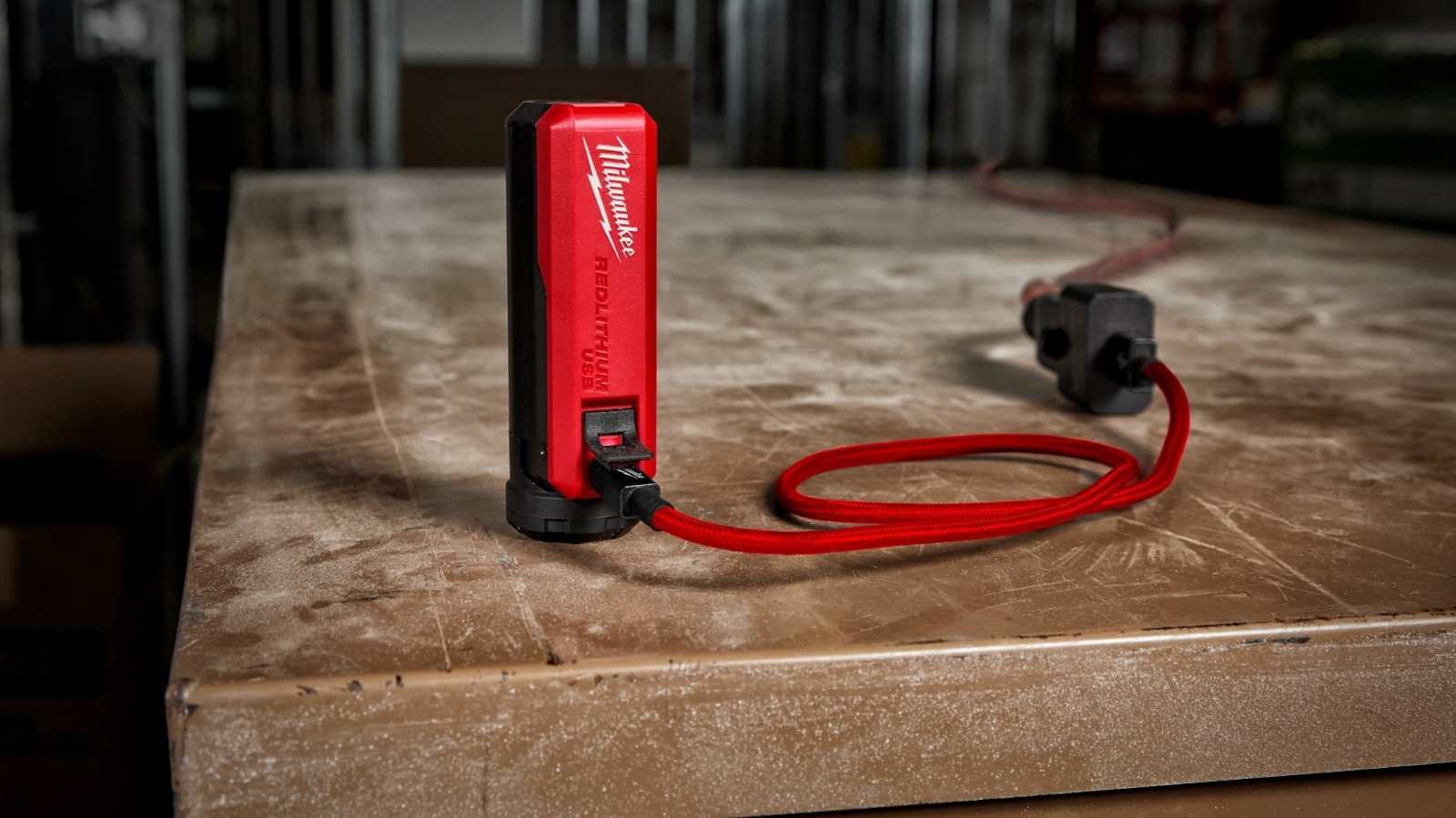
Milwaukee’s Redlithium batteries generally do a good job powering the tools and products they’re designed for, but the company also offers a kit that lets you use those batteries to charge other USB devices. Enter the $50 Redlithium USB Charger and Portable Power Source Kit, which includes a single Redlithium battery, a heavy-duty two-foot USB-C cable with brand-appropriate red sleeving, and the star of the show, the USB Rechargeable Power Source and Charger itself.
The power source does double duty here: It lets you use a Redlithium battery to charge other devices via its USB port, but you can also use it to charge the battery itself. It also includes an LED charge indicator so you can tell how much juice is left in your battery at a glance.
Now, given that even Milwaukee itself only advertises its batteries as offering double the capacity of three AAA batteries, you shouldn’t expect to fully charge a smartphone with one of these kits; if that’s what you need, just buy a good portable phone charger instead. Think of this more as something to add to your toolbox for emergency situations if you’re already invested in the Redlithium ecosystem. It’s also handy if you have multiple Redlithium batteries, as you can charge one while using another, ensuring you always have a charged battery ready to go.
Rover Pocket Flood Light
Milwaukee’s Redlithium line takes advantage of its small batteries to offer compact yet useful lighting solutions for those working in cramped spaces or who simply don’t have the capacity to lug a big light. Another example is the USB Rover Pocket Flood Light, which, at 6×1.33×1.25 inches (LxWxH) and around 0.4 pounds, is indeed small and light enough to slip in a pocket without being too uncomfortable.
The LED array outputs 445 lumens of light, which, while not necessarily outstanding, should be more than enough for the use-cases this light is designed for. Its two magnet clips allow users to choose the orientation at which it attaches to a metal surface, which is a nice touch for tight environments. It should also help users make the most of the light output by allowing them to place it as close as possible to the object or device being worked on.
Those who want to conserve battery life can run it in a 100-lumen mode, which extends runtime to 11 hours, a big increase from two hours at max brightness. Befitting a product designed for job sites, this flood light is IP54 water- and dust-resistant and has an impact- and chemical-resistant lens. It comes with a USB-C cable and a single Redlithium battery. Home Depot users are generally positive about the tool, but battery life and durability issues mean it has a so-so 3.8-star rating from over 430 users.