Sports are not neutral. They are a political battlefield. This is especially true along the color line in America. These moments can consist of singular events: Jackie Robinson breaking the color barrier in Major League Baseball, Tommie Smith and John Carlos raising their black-gloved fists in defiance against American injustice at the 1968 Olympics, Jack Johnson and Muhammad Ali mastering the sweet science of boxing and delivering devastating blows against Jim and Jane Crow white supremacy and its assumptions about the mental, intellectual and physical inferiority of black people.
Black women are central to this story as well. Althea Gibson was the first black woman to break the color barrier in professional tennis. Decades later Venus and Serena Williams are trailblazing pioneers for their skill and dominance in women’s professional tennis.
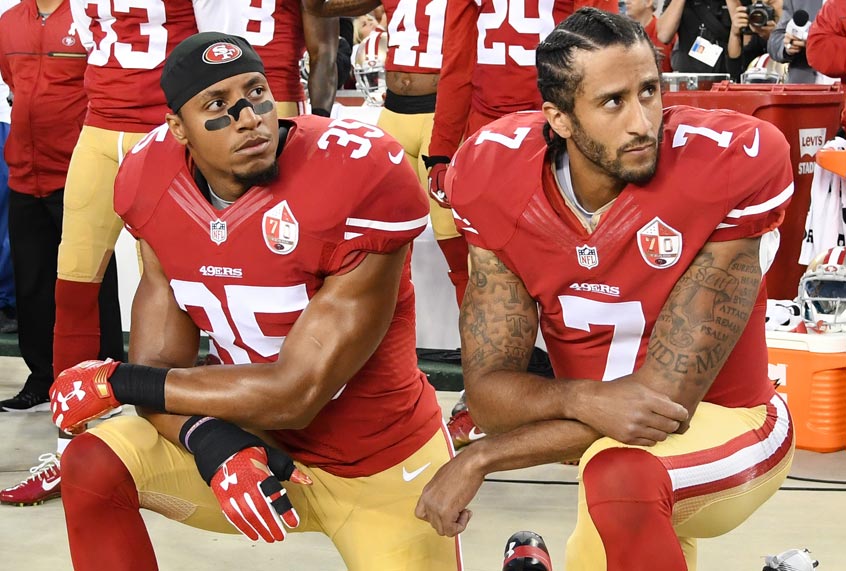
More recently, of course, there is former NFL quarterback Colin Kaepernick and other black athletes (along with a few white ones) who have taken a knee during the national anthem to protest oppression and social injustice in post civil rights America.
There has been blowback, of course: Donald Trump won a presidential election (if only by a fluke) and remains remarkably popular among Republican and other white right-wing voters. At least in part, this reflects his strategy of condemning and threatening black athletes who dare to stand up for the value of black lives.
The politics of sports are also revealed in systemic and institutional ways. In American professional sports the vast majority of teams are owned by rich, older white men. Black and brown bodies perform on the sports field, sacrificing their mental and physical health as the raw fuel for corporate and collegiate sports franchises worth millions if not billions of dollars. Girls and women do not have the same access to sports — and the profits and privileges and opportunities that come with them — as boys and men.
Professional sports teams receive enormous subsidies and protections from local communities and taxpayers, while many of those same communities are struggling to provide basic services. The U.S. military uses the NFL and other sports as a tool for recruiting young people into its ranks. The jet and helicopter flyovers, the American flags and the frequent appearance of uniformed troops on the field are a superficial form of patriotism whose primary function is to legitimate nationalism and militarism.
Sunday’s Super Bowl game between the New England Patriots and the Los Angeles Rams will be a spectacular display of the many ways that sports are political, and not an ideologically neutral or safe space.
How and why has Donald Trump targeted black athletes in his “culture war” strategy? Why has Colin Kaepernick become so despised by many white sports fans (and some black and brown ones as well)? How do black athletes — and the public response to them — represent America’s long and problematic history along the color line? How does white privilege operate in how athletes such as Tim Tebow and Tom Brady are perceived and treated? Are black athletes held to a higher and more difficult standard of civic responsibility?
In an effort to answer these questions I recently spoke with David Leonard, a professor in the Department of Critical Culture, Gender and Race Studies at Washington State University. He is the author of several books on race and politics in sports, including “After Artest: The NBA and the Assault on Blackness” and the recently published “Playing While White: Privilege and Power On and Off the Field.”
This conversation has been edited for clarity and length.
How did this moment with Donald Trump, who is now entering his third year as president, come to be?
In many ways, we’ve always been here. We’ve just had different chapters, different manifestations of the same history of inequality, of racism and of misogyny. In the most immediate moment, Trump can be viewed as a backlash to the election of President Obama. You can see the backlash against demographic shifts. You can see it as a backlash against cultural change.
Trumpism is a continuation of hundreds of years of history. But now filtered through spectacle, consumerism and loneliness, where we go from one moment to the next without any grounding or context.
Why do sports matter in this moment? Why does Colin Kaepernick matter in particular?
Kaepernick matters because sports are political. The fact that there is so much anger directed at him demonstrates the investment in sports as a particular type of political project where nationalism and militarism and where black bodies are required to “shut up and play.”
Kaepernick also matters for those who care about justice, because he’s a reminder of the power and potential of sport as an instrument of change.
But we also have to be careful. Too many people have reduced the Revolt of the Black Athlete 2.0 down to him. There have been other moments of resistance, such as WNBA players protesting and college athletes protesting in recent years, and other resistant moments as well. We have a tendency to reduce a movement down to a single individual — in particular a male, charismatic figure who has a national spotlight on him.
Movements are bigger than single individuals. In the case of Kaepernick you have him kneeling about the persistent violence directed at the black community, about police violence, about systemic racism, about Flint. We all too often get stuck focusing on the act of protest and not on what is being protested.
How would you respond to people, especially white folks, who would say that politics should be kept out of sports?
How comforting. It must be a wonderful place of privilege to see sports as apolitical for that black athlete who deals with racial slurs coming from the stands or that young girl who wants to play sports but is denied access, who has to hear parents or coaches talk about how she “throws like a girl.”
When we look at the mistreatment athletes, those playing sports around the globe, those who work in stadiums and build stadiums, it must be nice to think of that all as an apolitical space. There are countless examples of how sports are political, such as the national anthem being played, or military planes flying overhead, or the fact that the coaches or general managers or athletic directors are overwhelmingly white men.
The discourse around sports and athletes is also very political. For example, when black athletes are talked about differently than white athletes. Black athletes are very often described as being “selfish.”
Ultimately, the history of racism and racial politics are embedded in sports culture. To those who object to black athletes taking a knee in the NFL or elsewhere I would say, “So you want protest to happen in a place that isn’t disruptive to your daily life. Where is that place?” When you tell me that place, my question would then be, “When a protest happens in that place, will you support it?”
You hear people who say, “I support the cause, but not the method or not the place.” My question is, how do you support the cause? What are those people doing? How are they demanding change? Because part of the reason, historically, that black athletes use the platform of sports is because other spaces have been closed off. This is a silencing of not only protest, but the voice of people saying that these are our lived realities.
If you don’t want sports to be used, then what other spaces would you prefer? Whether it be workplaces, place of worships, schools or other parts of the public sphere, there is a long history of white Americans saying, “Protest, but just not here. This isn’t the appropriate place. This isn’t the appropriate time.”
This policing of black athletes is also part of a broader tradition in America and the West about the control of nonwhite bodies and submission to white authority.
What sports remind us is that there is a secure place for black bodies when they are doing the “proper work.” When black bodies are doing the work that is profitable, that is desirable, that authenticates a story of American exceptionalism and of racial progress.
From the protests of WNBA players to Kaepernick and to high school athletes as well, these protests aren’t simply against persistent anti-blackness in American society, they are also a demand to be heard. They’re also saying, “No, I will not shut up and play. My existence isn’t predicated on touchdowns. My existence isn’t predicated on winning a championship.”
A comparison between how Tim Tebow and Colin Kaepernick are treated is a stark example of white privilege and white entitlement.
There are multiple levels of white privilege at work with Tim Tebow. Likewise, similar dynamics are operative with Tom Brady putting a red Trump hat in his locker, or any number of college football coaches coming out in support of Donald Trump or making statements about the Black Lives Matter movement.
Certain athletes and those connected with sports are empowered to be political. It is not that sports should not be political. Rather it is that it is OK if it is a certain kind of politics, being practiced and engaged in by certain people. Therefore, whiteness is the ability to engage in politics or not to engage in politics. Whiteness is the power to assert oneself by choice and at will.
Considering Tim Tebow as an example. The black athletic body at rest is seen as unproductive, worthless and not valuable. Whereas Tebow resting and praying is seen as not only OK but desirable. Why? Because it authenticates this notion of the white athlete bringing morality, civility and religiosity into the sporting world.
Tebow, who was kneeling — which puts a spotlight on himself — is somehow seen as focusing on something bigger before the world. He is supposedly putting his relationship with God first. And yet Kaepernick was putting justice, putting black lives, putting any number of men, women and children whose lives were taken needlessly and unjustly first and before his own immediate personal self-interest. Yet Kaepernick is somehow criticized as being selfish.
Tebow also exhibits the power of whiteness in terms of how a person is celebrated as a leader, a role model, such a winner that he was afforded multiple opportunities to have a career. Tebow hits a home run in Double A baseball and it becomes breaking news on sports radio and TV. This also reflects the longstanding investment in the white quarterback as a cultural figure. A quarterback is imagined as being the most intelligent player on the football field and also the team leader.
Those same qualities are also still seen in American culture as being the purview of white men. This same logic justifies and normalizes the hiring of white men as CEOs, as being president of the United States, as being the “rightful” and “normal” leaders in America. Such racial logic gives Tim Tebow a platform and denies one to Colin Kaepernick.
What do the videos of people burning Nike sneakers in response to the Kaepernick ad reveal about the politics of sports and society? Those videos are very evocative of spectacular lynchings and other types of violence against black bodies.
This is again an investment in a certain type of politics and sport. Kaepernick and other black and brown athletes who kneel in protest against racism and injustice are such an affront to a certain type of (usually) right-wing politics that he should be kicked out of the NFL and his whole life destroyed.
Burning the Nike sneakers also speaks to the level of anger and betrayal that his protest elicited. This shows us that there is a significant investment in sports as authenticating American exceptionalism.
The anger at Kaepernick and burning the Nike sneakers also shows how invested as a culture the American people are in brands. People define themselves through their phones, shoes and even their headphones. So you have people who believe that Nike defines their identity seeing an athlete associated with that brand fighting for racial justice. It is personal for them. They do not believe in the same things. It is almost like Nike betrayed them.
There’s other reading of Nike’s ad campaign with Kaepernick. How “resistant” or “oppositional” is it really for him to be allied with a multibillion-dollar global corporation that exploits children in sweatshops.
We can’t have it both ways. We can’t simply talk about profit-driving fostering injustice and then make an exception when there is a cause or leader we agree with involved with a corporate actor.
Part of people’s response to Nike’s campaign with Kaepernick feels like more of a celebration of him getting paid after losing out to the NFL. There needs to be a discussion of Nike and other global corporations and the context of capital, racism and the exploitation of children — especially children of color around the globe — working in the apparel industry.
Is Nike supporting Kaepernick’s politics and struggle? I have yet to see Nike support the movement for black lives. Even the inclusion of Kaepernick in the ads does not make reference to the protests. There is also no reference to the larger movement.
There is a dimension here where these critical questions are not being asked, because people are reasoning that if Donald Trump is critiquing Nike then I am by definition on the other side opposing him and what he stands for.
The relationship between Nike and Kaepernick — and of these corporations and social-change work in general — does minimize the actual struggle for racial justice and the courage involved. Taking on a sport you didn’t think you could do might be a type of courage. But that type of courage and standing up against the state and oppression are very different.
The hyper-individual neoliberal mantra “Just do it” is a theme going back to Nike’s advertising campaigns with Michael Jordan.
What happens when you “just do it” and the state comes down on you? What happens when you “just do it” and the powerful take everything away from you?
How should we think about generational differences regarding the politics of the black athlete? NFL legend Jim Brown is very conservative in terms of economic policy — going back to Nixon and “black economic empowerment” — and has been critical of Kaepernick. He also supports Donald Trump.
Your point is one that really has not been highlighted enough. Jim Brown has said that Kaepernick has the right to protest and take a knee, but that would not be his approach. It should not be shocking that Brown supports Trump. If you look at the history of black economic nationalism, something that Jim Brown embraced, one of its major ideas is self-determination simply through capital.
But that becomes a convenient way of diminishing black youth, whether it be black youth shutting down freeways or Kaepernick kneeling or high school and college students protesting. Invoking previous generations of black athletes can be used in a very conservative and reactionary way to marginalize and undercut protest movements at work today.
Therefore you will see a narrative where it goes something like, “Look, Jim Brown, one of the foremost athletes who ever protested, he even tells you you’re out of line.” This is the same playbook that was used in the 1950s, 1960s and 1970s against the black freedom struggle. These generational tensions within the black freedom struggle and other human rights movements are really nothing new.
I have heard the following argument made at my local barbershop, and I will admit in some ways I agree with it. Why wouldn’t Kaepernick just be quiet for now, play, get all the money he can, and work behind the scenes to do his political work? Then when he retires and has all that money saved he can say and do anything he wants, and do so with even more resources at his command.
What do we know about the history of African-American and other athletes, in terms of how those calculations are made? The fact that black athletes have to make such a calculation and that white athletes generally do not tells us everything we need to know. The fact is that white athletes can decide whether to be political or not. Whereas for black athletes there is a backlash no matter what.
For those who focus on the sport and do things behind the scenes, they are then criticized for not using their platform to create change. This happened with LeBron James.
Yet when James does speak out he’s told to shut up and play. It is very easy for white Americans to tell black athletes, “Why didn’t you do this?” Or “Why didn’t you take this approach?” or “Why didn’t you just give money?”
Yet there isn’t the demand placed on white athletes to engage in social and political change work. White athletes get a pass. Whether it be the pass that they get from the media of not being asked to take a position or the lack of expectation that they give back to their communities and the public or groups in crisis.
Why is there an expectation that LeBron James give back to Cleveland? What about other white athletes from Cleveland and Ohio?
It’s a lose-lose, right? If a black athlete speaks truth to power then he or she is a troublemaker because they are not living up to white expectations about black obedience. But if black athletes do not become involved politically or in other types of social-change work it becomes a narrative about black folks not being civically engaged, of them being bad citizens.
There are many examples of how the black athletes who speak up and engage politically are attacked as somehow betraying the traditions of Bill Russell and Tommie Smith. There is this flat understanding of the past which is used to demonize black athletes in the present.
It is as if Bill Russell or Tommie Smith or Althea Gibson were celebrated for protesting. No, they were demonized. They were punished, they were criminalized, they were treated as ungrateful, they were stripped of medals, among other things. So, it is a no-win scenario. White athletes, and white folks more generally, do not have that burden of expectation and confronting such a lose-lose scenario.
When, for example, white athletes do engage in any form of protest it is treated as “breaking news” and something to celebrate. See all the attention when Tom Brady liked the Instagram photo of the Kaepernick Nike ad. Should Brady get a medal? So what? He liked a Nike ad? There are white athletes, very few but still noteworthy, who have done so much more.
There is a deep convergence between right-wing talk radio and other media and sports talk radio and media. This is very apparent in the animus against Colin Kaepernick, Venus and Serena Williams and other black athletes.
I do think there is a shared history there. Beyond questions of media consolidation and ownership, those are both spaces that reinforce white male power and a particular understanding of the role of sports in society as a whole. Right-wing talk radio and sports talk radio also leverage a particular type of white anxiety about demographic change in America as well.
Do you think Trump’s animus towards black athletes as part of the right-wing culture war strategy will be enough for his voters to overlook his many failings and to reelect him in 2020?
It is an element. Trump’s use of culture-war narratives against nonwhites and other marginalized groups is part of the glue that will hold his electoral coalition together. In all, this reveals a great deal about the power of sports and the investment in sports as a racial political project.