




When I moved to Chicago, I assumed I would become a slightly different person.
Not in the wholehearted country-song sense, where crossing the county line might allow me to outrun myself. The reinvention I had in mind was more municipal than spiritual: perhaps a change in infrastructure might produce a corresponding improvement in character.
I was moving without my car, so I would naturally become someone who walked, biked and took the train more. Our apartment was about ten minutes from Lake Michigan; perhaps proximity alone would turn me into one of those women who began the day with a brisk swim. At the very least, I would develop strong opinions about beach sandwiches.
And I would be living within walking distance of a sickening number of farmers markets.
Of course this would become part of who I was.
The life I pictured appeared in View-Master slides, each image crisp and complete, with all the inconvenient connective tissue outsourced.
Click. I’m on the train.
Click. I’m wheeling my bike off it with balletic ease, definitely not annoying my fellow commuters as I lug it down the stairs.
Click. I’m wearing a helmet that looks chic rather than orthopedic.
Click. The helmet — and any evidence that it has touched my hair — has disappeared. I am now carrying a gorgeous straw tote and wearing linen that has somehow survived public transit without acquiring a wrinkle.
Click. Farmers market stalls.
Click. Farmers market haul.
Click. A thrown-together dinner party on the rooftop of my building for all my neighbors. Yes, it overlooks a nest of alleyways, and no, management does not like people going up there, and no, I don’t know all my neighbors by name or even sight yet. But I have somehow assembled enough glittering people and enough secondhand objects — a woven rug, cushions, low tables, an impossible number of candles — that it feels like a tiny seventh-floor pop-up restaurant.
In my imagination, even the building superintendent has been cast. He arrives to break up the party with the energy of the businessman who plans to level the summer camp until he witnesses the final talent-show number. Then he takes a bite of the olive oil cake I have made for dessert. He softens. “Maybe we should do this more often,” he says.
What I had not pictured was shopping.
In the View-Master version, the market haul arrived already edited. There were no prices to compare, no heavy bags to carry home, no stalls selling six unrelated things I suddenly believed might change my life. I would wander in with my perfectly sized tote, allow whatever charmed me to determine dinner and wait for the ingredients to organize themselves.
Later, when someone praised the meal, I would demur in the manner of women for whom this sort of thing came naturally.
“Oh, this?” I would say. “Just something I threw together.”
I was a farmers market failure.
This remained true for an embarrassingly long time — including several years when I was already being paid to write about food. I knew how to want everything at a farmers market. I simply did not know how to shop at one.
The clearest evidence came one late-summer afternoon, when several weeks of bad weather produced a scheduling anomaly: two neighborhood farmers markets on the same day. The vendors posted flyers and made an occasion of it.
The first occupied a roped-off parking lot beside an elementary school. I left home with $45 in cash—which felt ample, even indulgent—and one of the crinkly blue totes I had picked up on our last trip to the suburban IKEA.
The day was sticky enough that the plastic adhered to my bare shoulder. Every few minutes, I peeled it from my skin and transferred it to the other side, where it promptly attached itself again. The chic tote from the View-Master apparently had another engagement.
Everyone at the market seemed either to have a distinct plan or to be genuinely content wandering. A mother steered a stroller while consulting a list. A white-haired man in a Tommy Bahama shirt amiably haggled two dollars off his peaches. Another man had a shallot tattooed on his forearm, suggesting either a career behind the line or an allium devotion I could not hope to match.
I wanted to resemble the relaxed browsers who paused over a melon because its scent had summoned them. In fact, I am much more comfortable with a list. I hadn’t learned yet that I was a Type A person masquerading as Type B. The disguise began to fray almost immediately.
Want more great food writing and recipes? Sign up for Salon’s free food newsletter, The Bite.
I completed one slow circuit, attempting to look discerning. Nearby, a woman with timeless preschool-teacher energy played the accordion for a ring of toddlers as shoppers crowded around nearly white ears of sweet corn. Then I noticed things were disappearing behind me. Baskets I had paused over were emptier when I returned. Someone bought the last loaf of a bread I had not yet decided whether I wanted.
This sent me into a faster orbit.
The accordion sounded louder.
To steady myself, I bought a $12 arancini from a stall that accepted only cards. Because I had designated the cash as my farmers market budget, the card purchase belonged to a parallel economy; by this logic, my $45 remained intact. Arancini in hand, I passed a booth lined with turquoise jewelry, Coca-Cola merchandise and approximately 40 embroidered denim vests. It looked as though the vendor had raided a secret convention of 1990s elementary-school teachers and persuaded them to turn in their uniforms.
Then I made a beeline for the heirloom tomatoes.
I chose two: one ridged and heavy, its skin receding from burgundy into a deep, almost plum color; the other a cheerful red beefsteak. They were fat and beautiful and cost about $8. A woman carrying two heirloom tomatoes could still plausibly claim to be shopping for dinner. I was back on course.
The plan splintered almost immediately. I ping-ponged from soft cheeses to eggs and squash, then past a gelato cart and a table crowded with jams, pepper jellies and a milk carton filled with VHS tapes.
Finally, I arrived at the pastry stall.
It was run by a man in his early 40s with a single gold hoop and a tight gray bun. I had never before described a man bun as severe, but no other word will do. He was arguing with another vendor in the unmistakable register of people with history. “You’re always like this,” one of them said. “I’m not sure why we’re even doing this again.”
I studied the pastries while pretending not to listen: tea-infused buns knotted with candied citrus, laminated pastry layered with spiced cream cheese, craggy oat muffins dotted with boysenberry preserves. I waited for a lull. I misjudged it.
There was no visible menu, so I began, “Excuse me, how much—” just as the baker turned toward the other vendor. “Do you remember last August?” he demanded.
There was an awkward two-second collision. Then he looked at me.
“Prices are marked,” he hissed.
I could have walked away. Unfortunately, I have always struggled with disappointing authority figures: professors, bosses, priests, parents — and, apparently, severe-bunned bakers. I pointed to two oat muffins.
“For breakfast,” I told myself.
They were $7.50 each. I wanted them, though not $15 worth of them, but by then “Well, actually…” was beyond me. I paid and tucked them beside the tomatoes.
The bag remained almost offensively empty. For $23 in cash, it contained four objects, all of which now had to be protected from one another. Still, I had just over $20 left. The arancini did not count. The muffins were breakfast. Dinner remained possible.
I could turn this around.
I just needed to go to the second market.
It turned out to be both prettier and worse.
The vendors occupied a tree- and bench-lined pedestrian stretch that I once overheard two teenagers in airbrushed wolf T-shirts nominate as the neighborhood’s most romantic place to smoke a joint. They may have been right about the romance. Unfortunately, everyone else had arrived before me.
By then, the baskets had been picked over. The best things had departed in the totes of people who knew what they were doing. I walked one more circuit, attempting to let the remaining produce speak to me.
I bought a jar of blackberry jam because it sounded good.
Then, on the way home, I stopped at the corner store and spent the rest of my cash on a frozen pizza.
Back at the apartment, I unpacked. Everything from the markets was beautiful, delicious or both. It simply did not add up to the thing I had gone there to find.
The only dinner in that day’s haul had come from the freezer aisle.
This shouldn’t have been a surprise, really. It was not as though the open air of a farmers market was going to cure my base shopping instincts. Put me in a grocery store without a plan and I move through the aisles like a dog with the zoomies: produce, meat, back to produce, an abrupt dairy detour, then three aisles in reverse because I have remembered lemons.
For a long time, I assumed the solution was to become more instinctive. Food culture is inordinately fond of nonchalance: meals that are “almost too easy,” cakes that come together “in a snap.” It reminds me of how, recently, my younger sister — deep in the trials and tribulations of planning her wedding look — called me sounding breathless and almost conspiratorial. “Did you know pop stars wear hair extensions?”
Effortlessness, we agreed, generally has at least a little scaffolding underneath.
Perhaps the market shoppers I envied had simply made a few decisions before everything started charming them.
My reeducation began, as many good things do, with pasta.
I had rigatoni, olive oil and butter at home, which meant one good vegetable would be enough. Zucchini could be grated and cooked down until jammy, then loosened with pasta water; tomatoes could be sliced, salted and left to steep in olive oil. Cheese would be a bonus.
I wrote a two-item list: Good vegetables. Good cheese.
Then I took a beat and added: Pastries for morning.
I gave myself a five-purchase limit, leaving two slots open for surprise.
At the market, I moved differently. With dinner already half-imagined, I could pass the tomatoes and melons without treating each one as an alternate future I might regret abandoning. Instead, I gravitated toward a pile of thin-necked yellow summer squash. The day was in the low 70s, and a breeze was coming through our kitchen window; I decided I would not mind standing at the stove long enough to coax the squash toward sweet collapse. Because one caramelized vegetable is good and two are better, I added a white onion.
Then I followed my list to the cheese stall, where I found a soft chèvre, and to the baker (a different one, blessedly) for croissants and a hunk of cornbread, which I naturally counted as a single purchase. My wildcards were honey, for the vegetables and leftover cornbread, and basil, mostly for color and romance.
At home, I cooked the onion and grated squash in butter with a spoonful of honey, miso and red-pepper flakes until they became jammy. I crumbled some of the cornbread into olive oil and toasted it in a skillet. Then I added the rigatoni and enough pasta water to turn the vegetables velvety, finishing each bowl with the crisp crumbs, little pillows of chèvre and torn basil.
In a way, it really was something I had thrown together.
But the ingredients had not organized themselves.
I had given them somewhere to land.
How I shop the farmers market now
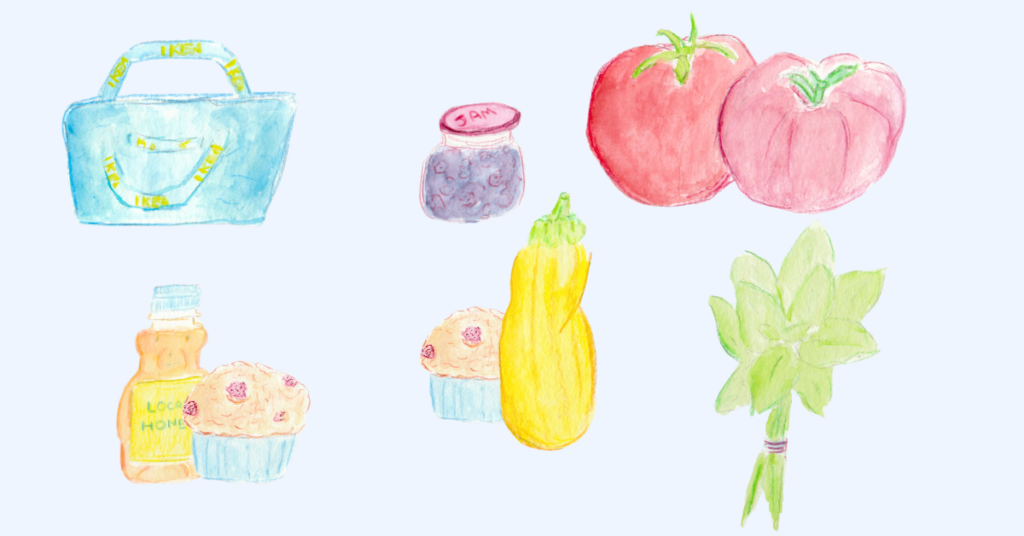
(Ashlie Stevens ) IKEA tote, and contents
The point was never to become less susceptible to the market’s charms. It was to stop asking every beautiful thing to become dinner. Here are five simple tips I keep in mind to let the market surprise me without leaving dinner to chance.
Choose a form, not a recipe
Even a well-stocked farmers market rarely behaves like a supermarket organized around a recipe’s demands. It offers what is there, in the quantity there is. A useful form already provides enough structure — a base, a binder, a vessel — that whatever looks best can find a place within it.
One tomato may not look like a grocery haul, but with bread, mayonnaise and an egg, it is dinner. A handful of mushrooms that seems meager in a paper bag can become the center of a frittata. A single bunch of greens can be folded into beans, piled onto toast or wilted through cheesy rice.
The form supplies the logic. The market supplies the surprise.
Start with the kitchen you already have
A farmers market is not a complete food system. It is exceptionally good at providing the vivid part of dinner — the ripe tomato, the thin-skinned squash, the bunch of herbs still cool from the morning — but it may not provide the starch, protein, fat, acid or seasoning required to turn those things into a meal.
That is what the kitchen at home is for.
Before I leave, I “reverse-shop” my fridge and pantry, taking stock of the support system already in place: pasta or rice, bread or tortillas, eggs, tinned fish, tender white beans; butter, olive oil, yogurt, vinegar and whatever cheese is threatening to fossilize in the refrigerator.
I jot those ingredients at the bottom of my market list. Seeing eggs, rice, yogurt in writing makes it easier to recognize what a bunch of greens or a basket of cucumbers could become—and easier to pivot when the ingredient I imagined isn’t there.
The market ingredient does not need to do everything. It only needs to be good.
Set a limit, but leave room for surprise
A rigid list can make a farmers market feel like a slightly understocked supermarket. I have better luck shopping for roles rather than exact ingredients: Good vegetables, good cheese, pastries for morning.
Perhaps the squash looks better than the zucchini. Perhaps the cheese is a bloomy little wheel rather than chèvre. The role remains useful even when the ingredient changes.
Then I decide roughly how many purchases I want to make. Three items may be plenty for tartines; a big, maximalist salad could happily accommodate eight or ten. The number is not sacred. It simply gives me a stopping point before I begin believing every peach, pickle and pastry belongs to the plan. When necessary, I set a spending limit, too. Other weeks, a predetermined number of decisions is enough.
I also leave room for wildcards. They might improve dinner—herbs, honey, good bread, something pickled—or have nothing to do with it: flowers, jam, a spice blend, a VHS tape, an embroidered denim vest.
Impulse is part of the pleasure. It simply does better with a little containment.
This also preserves the culinary reason for the limit without overpronouncing it: farmers market ingredients are usually best when they remain recognizable. You don’t need to cram every beautiful thing into the same dinner merely because it came home in the same tote.
Let one excellent thing be enough
On that note, a successful trip does not require a photogenic avalanche of produce.
One excellent vegetable can be cooked down with butter and tangled through pasta. One tomato can be grated onto toast. A small bundle of herbs can sharpen a bowl of rice and beans. A few peaches can become dinner with cheese, bread and something salty.
The smaller the minimum, the less likely you are to buy six unrelated ingredients in the hope that abundance will eventually explain itself.
Let the market be incomplete
Sometimes the stalls are picked over. Sometimes the beautiful thing costs more than you want to spend. Sometimes the market is rich in soap, flowers and decorative squash but not in dinner. Pivot to another generous form. Stop at the supermarket for eggs or bread. Buy one jar of good jam for the pantry and go home.
And when the entire enterprise has ceased to sound fun, there is always frozen pizza.
Dinner should not be held hostage by the farmers market.
This story originally appeared in The Bite, my weekly food newsletter for Salon. It is the first half of this two-part farmers market special. Next week, I’ll be back with five flexible recipes to keep in your pocket for market day—including the jammy squash pasta with chèvre and cornbread crumbs that started this whole reeducation. There will be options for tomatoes, greens, fruit and the miscellaneous beautiful thing you bought before deciding what it was for. Subscribe here to have it sent straight to your inbox.
Read more
from “The Bite”