
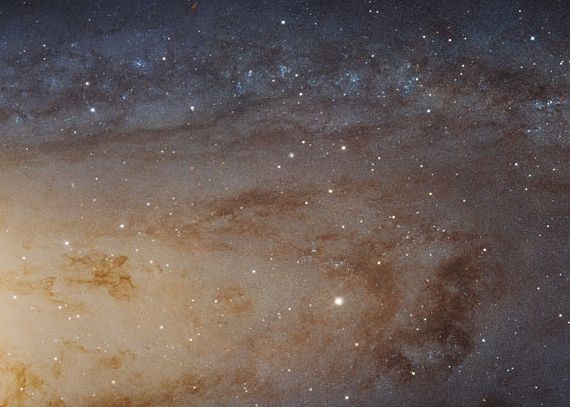
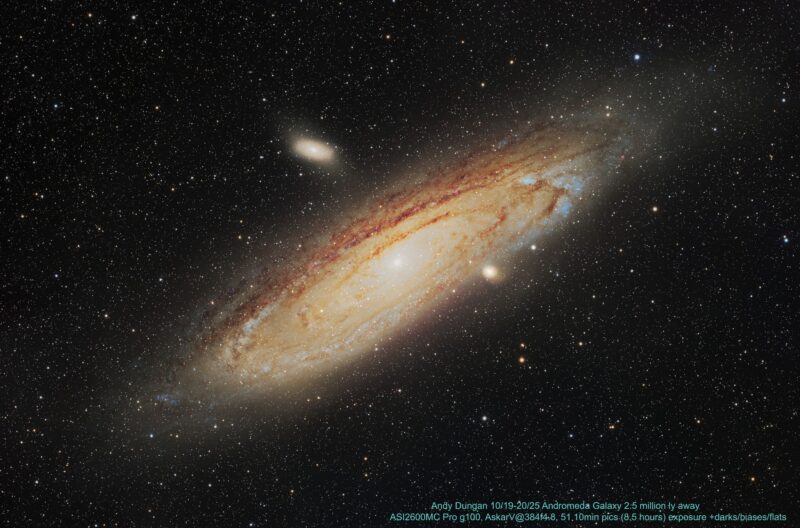
- Andromeda is the closest spiral galaxy to our own Milky Way galaxy.
- It’s visible to the unaided eye on clear, dark nights.
- Andromeda is about twice the size of the Milk Way, with roughly one trillion stars.
The large spiral galaxy next door
The Andromeda Galaxy is the closest large spiral galaxy to our own Milky Way galaxy. Excluding the Large and Small Magellanic Clouds — both visible from Earth’s Southern Hemisphere — the Andromeda Galaxy is the brightest external galaxy visible in our night sky.
And, at 2.5 million light-years, it’s the most distant thing we humans can comfortably see with the unaided eye.
You might argue the large spiral Triangulum Galaxy is slightly more distant at 2.7 million light-years, and sometimes visible to the eye too. But it’s turned face-on to us, and so it has a low surface brightness. That makes it a challenging spot compared to the Andromeda Galaxy.
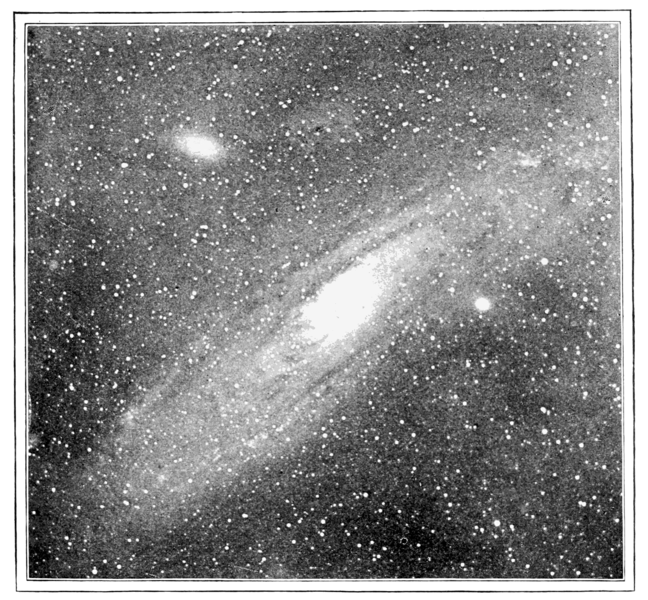
Astronomers sometimes call the Andromeda Galaxy by the name Messier 31, or M31. It was the 31st object on a famous list of fuzzy sky objects compiled by the French astronomer Charles Messier (1730-1817). His catalog listed objects to avoid when comet-hunting. Nowadays, amateur astronomers seek out these objects with their telescopes and binoculars. They’re some of most beautiful deep-sky objects known.
Most Messier objects are star clusters or gas clouds in our Milky Way galaxy. But the Andromeda Galaxy is a whole separate galaxy, even bigger than our Milky Way. In a dark sky, you can see that it appears large on the sky as well; it’s a smudge of distant light larger than a full moon.
When to look for M31
From mid-northern latitudes, you can see Andromeda for at least part of every night, all year long. But most people see the galaxy first around August or September, when it’s high enough in the sky to be seen from evening until daybreak.
In early September, begin looking for the galaxy in mid-evening, about midway between your local nightfall and midnight.
In late September and early October, the Andromeda Galaxy glows in your eastern sky at nightfall, swings high overhead in the middle of the night, and stands rather high in the west at the onset of morning dawn.
Winter evenings are also good for viewing the Andromeda Galaxy.
If you’re stargazing far from city lights during a moonless night in late summer, or on any autumn or winter evening, it’s possible that you’ll simply notice the galaxy there in your night sky without looking for it
But if you don’t manage to spot that fuzzy spot on the sky, you can star-hop to find the galaxy in one of two ways. The easiest way is to use the the Great Square of Pegasus. Or you can also use the constellation Cassiopeia the Queen.

Use the Great Square to find M31
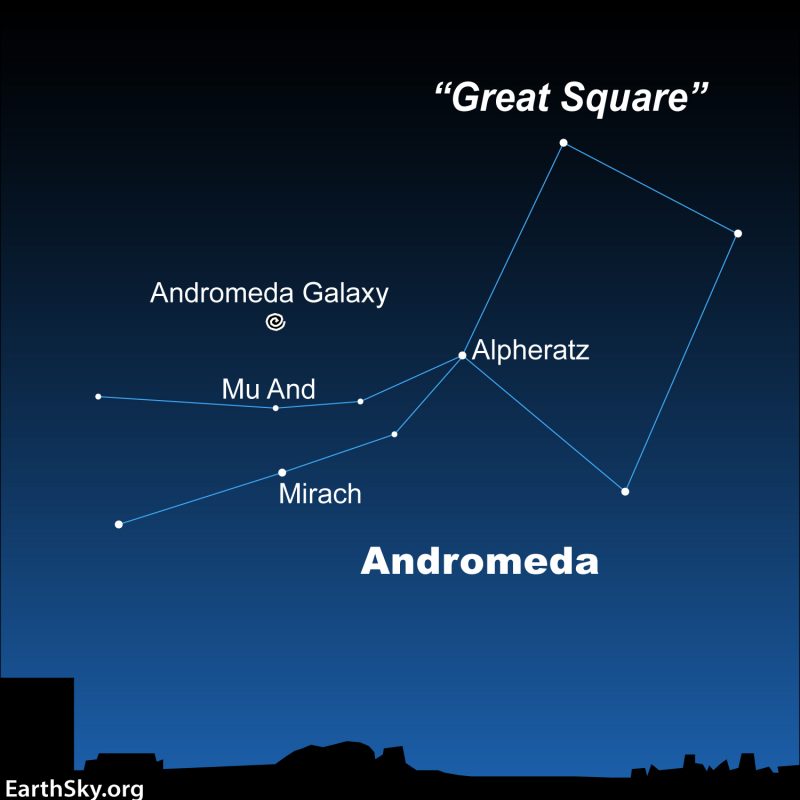
You can star-hop to the Andromeda Galaxy using the Great Square of Pegasus. In autumn, the Great Square of Pegasus looks like a great big baseball diamond in the eastern sky. Pick one corner of the Great Square as home plate, then draw an imaginary line from the ‘first base’ star through the ‘third base’ star to find two streamers of stars flying away from the Square. These stars belong to the constellation Andromeda the Chained Lady.
On each streamer, move two stars away from the ‘third base’ star to find Mirach and Mu Andromedae. Then draw a line from Mirach through Mu Andromedae and extend it about twice the distance between them. You’ve just landed on the Andromeda Galaxy, which looks like a smudge of light to the unaided eye.
Read more: Andromeda Galaxy: Find it by star-hopping from Pegasus
Or use Cassiopeia to find the Andromeda Galaxy
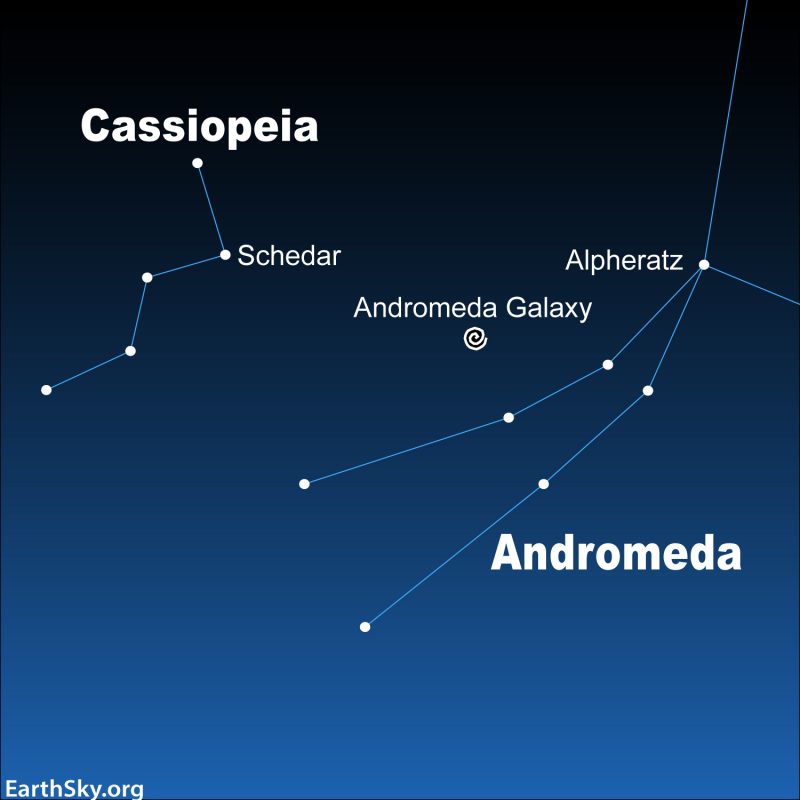
The constellation Cassiopeia is easy to find. Look generally northward on the sky’s dome for a pattern of stars shaped like the letter M or W. If you can recognize the North Star, Polaris — and if you know how to find the Big Dipper — be aware that the Big Dipper and Cassiopeia move around Polaris on opposite sides, so when one is high, the other is low.
Once you’ve found Cassiopeia, look for its star Schedar. In the illustration below, see how Schedar points to the Andromeda Galaxy?
Read more: Cassiopeia points to the Andromeda Galaxy
Our charts are mostly set for the northern half of Earth. To see a precise view from your location, try Stellarium Online.
Binoculars enhance the view
If you can’t see the Andromeda Galaxy with the eye alone, by all means use binoculars.
Binoculars are an excellent choice for beginners to observe the Andromeda Galaxy, because they are so easy to point. As you stand beneath a dark sky, locate the galaxy with your eye first. Then slowly bring the binoculars up to your eyes so that the galaxy comes into binocular view. If that doesn’t work for you, try sweeping the area with your binoculars. Go slowly, and be sure your eyes are dark-adapted. The galaxy will appear as a fuzzy patch to the eye. Naturally, it’ll appear brighter in binoculars. And can you see that its central region is brighter and more concentrated?
With the eye, binoculars, or with a backyard telescope, the Andromeda Galaxy won’t look like the images from famous telescopes and observatories. But it will be beautiful. Plus, it’ll take your breath away.
History of our knowledge of the Andromeda Galaxy
At one time, the Andromeda Galaxy was called the Great Andromeda Nebula. Astronomers thought this patch of light was composed of glowing gases, or was perhaps a solar system in the process of formation.
It wasn’t until the 20th century that astronomers were able to resolve the Andromeda spiral nebula into individual stars. This discovery led to a controversy about whether the Andromeda spiral nebula and other spiral nebulae lie within or outside the Milky Way.
In the 1920s Edwin Hubble finally put the matter to rest, when he used Cepheid variable stars within the Andromeda Galaxy to determine that it is indeed an island universe residing beyond the bounds of our Milky Way galaxy.
Andromeda and Milky Way in context
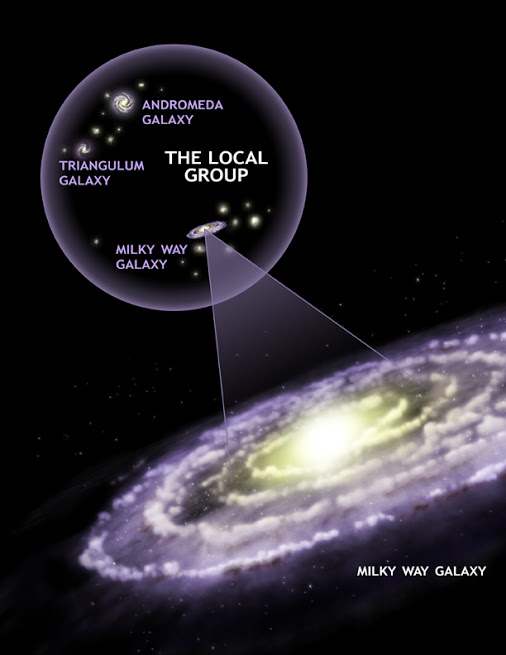
The Andromeda and Milky Way galaxies reign as the two most massive and dominant galaxies within the Local Group of galaxies. The Andromeda Galaxy is the largest galaxy of the Local Group, which, in addition to the Milky Way, also contains the Triangulum galaxy and about 50 other smaller galaxies.
Both the Milky Way and Andromeda have several dozen satellite galaxies. Each galaxy is at least 100,000 light-years across and contains enough mass to host billions of stars.
Astronomers have discovered that our Local Group is on the outskirts of a giant cluster of several thousand galaxies, which astronomers call the Virgo Cluster.
We also know of an irregular supercluster of galaxies, which contains the Virgo Cluster, which in turn contains our Local Group, which in turn contains our Milky Way galaxy and the nearby Andromeda Galaxy. At least 100 galaxy groups and clusters are located within this Virgo Supercluster. Its diameter is thought to be about 110 million light-years.
And the Virgo Supercluster is thought to be one of millions of superclusters in the observable universe.
Will the Andromeda Galaxy collide with the Milky Way?
One of our readers wrote:
I’ve heard that the Andromeda Galaxy will someday collide with our galaxy! Is that still a definite possibility?
A definite possibility describes much of what we know – or think we know – about the universe. As for the Andromeda Galaxy and its future collision with our Milky Way: the first attempt to measure the radial velocity of this galaxy (its motion forward or back, along our line of sight) was made in 1912. After that, astronomers believed for some decades that the galaxy was approaching at nearly 200 miles per second (320 km/s), but later astronomers disagreed.
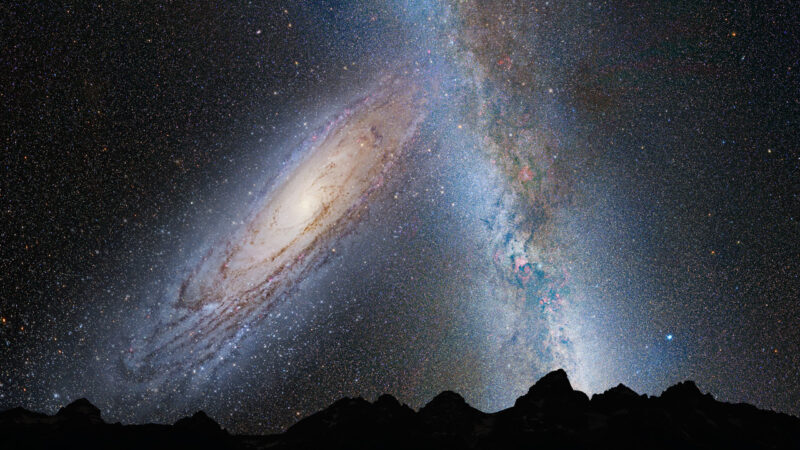
Then in May 2012, NASA astronomers announced they can now predict the time of this collision of titanic galaxies with certainty. Remember, though, that the Andromeda Galaxy is 2.5 million light-years away, with a single light-year being almost 6 trillion miles (10 trillion km). So although it does appear that this galaxy is approaching our Milky Way galaxy … it’s nothing to lose sleep over. When will they collide? According to NASA astronomers in 2012, it’ll be four billion years from now.
But, the collision between our galaxies might be already underway. Or at least our galactic halos – which consist of gas, dust and stray stars – may already be touching.
Read more: Andromeda Galaxy and the Milky Way are merging
When galaxies collide …
What happens when galaxies collide? They don’t exactly crash into each other. Because there’s so much more space than stars even in a galaxy, colliding galaxies pass through each other, like ghosts.
But, colliding galaxies do interact via gravity, which will cause them to change shape and even merge into a larger galaxy.
The Andromeda Galaxy (M31) is located at the coordinates RA: 0h 42.7m; Dec: 41o 16′ north.
Images of M31 from our EarthSky community
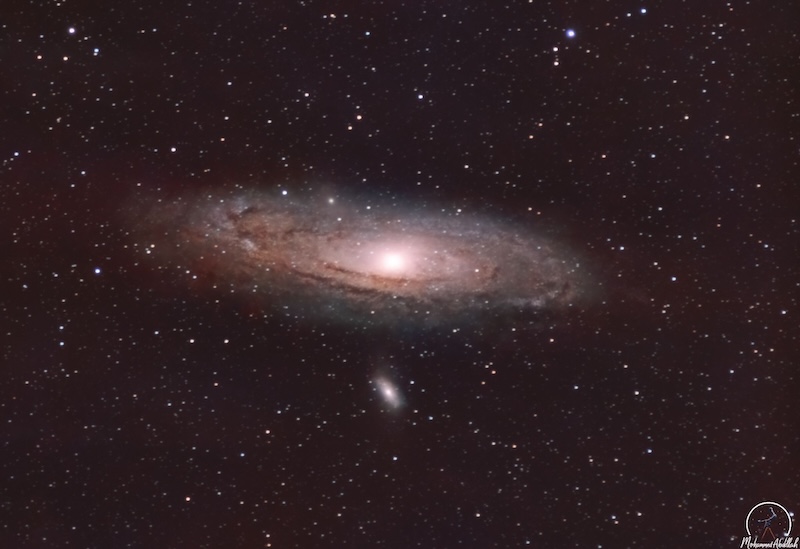
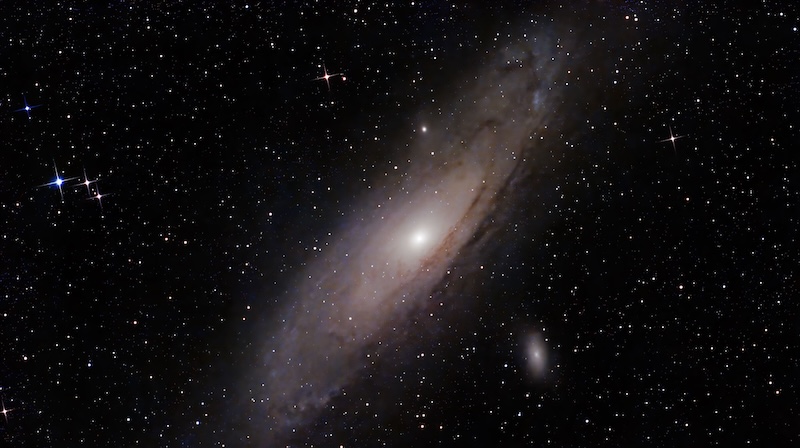
Bottom line: At 2.5 million light-years, the great Andromeda galaxy (Messier 31) rates as the most distant object you can see with the unaided eye. And it’s easy to spot in binoculars.
Read more: Andromeda Galaxy stuns in new images and sounds
Read more: New map of Andromeda Galaxy and its colossal ecosystem
Enjoying EarthSky? Sign up for our free daily newsletter today!