

Driverless cars, once a distant techno-optimist’s dream, are making their way into more cities, racking up miles and attracting a loyal fan base. They’re also increasingly racking up tickets and driving in ways that would land a human driver in hot water.
During July Fourth celebrations this year, several Waymo autonomous robotaxis operating near San Francisco’s Golden Gate Bridge reportedly hit technical trouble that led to at least one vehicle driving over an exploding firework with two passengers inside. The riders (who luckily escaped harm) said they smelled smoke coming out of the vehicle and promptly bolted at the next intersection.

Video shows Waymo driving over illegal firework in San Francisco
A couple of months earlier, a California driver claimed a pair of Waymos cut her off and blocked her from moving forward for nearly 50 minutes, causing a traffic pile-up and frantic 911 call. Halfway across the country, as many as five Waymos in Austin blocked police and emergency crews responding to an active shooting that left four people dead and a dozen injured.
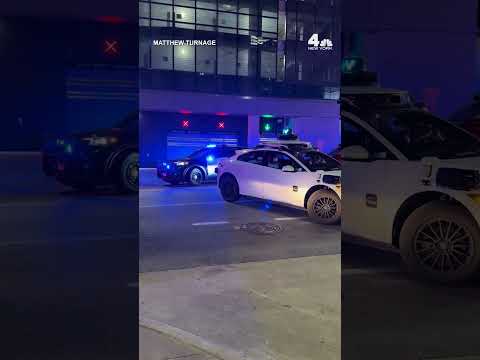
Waymo car blocks traffic during Austin mass shooting | NBC New York
“The question is not if this is going to turn into a deadly situation for someone, but when,” Austin City Council member Paige Ellis said at a meeting following that incident.
Human drivers in any of these situations would likely face a confrontation with police and the real possibility of a citation—or worse. But that calculus changes when there’s no one behind the wheel. Across the country, cities and states are still figuring out how to sanction a driverless vehicle that breaks the law, even as the well-financed companies operating them rack up thousands of dollars in parking tickets with seemingly few consequences.
To call the situation a work in progress is an understatement. Many localities that allow these vehicles on public roads still lack clear legal mechanisms for issuing moving violations. Where laws do exist, enforcement remains light-handed. Experts in autonomous vehicle (AV) policy tell Popular Science that this seemingly basic question, “what happens when a driverless car breaks the law?”, is still surprisingly complicated to answer.
“In principle, AVs are licensed drivers and someone owns and operates them,” University of Southern California Gould School of Law professor Gregory Keating tells Popular Science. “They should be treated like any other licensed driver.”
Despite spending years studying this very issue, Keating says the path forward remains hazy.
“In practice, I don’t know what’s going on,” he adds.
Driverless cars are racking up parking tickets
Cars breaking laws, whether driven by humans or algorithms, fall broadly into two categories: traffic violations and moving violations. Anyone who’s gotten a parking ticket is familiar with the former, and increasingly, so are driverless cars. In 2024, Waymo, by far the most common robotaxi operating today, accrued over 589 parking tickets in San Francisco and $65,065 in fines, according to The Washington Post. The Post reported another 75 tickets further south in Los Angeles. In Austin, where the company more recently started commercial operations, Waymo has reportedly received 20 parking-related citations as of June 23. Zoox, another robotaxi firm backed by Amazon, also received a citation for parking in a tow-away zone.
[Related: Why are ‘driverless’ cars still hitting things?]
Cops issuing those tickets basically approach it the same way as they would a car with a human driver. Matthew Raifman, autonomous vehicle and traffic lead at UC Berkeley’s SafeTREC, tells Popular Science that in these cases, it’s the vehicle, not any individual behind the wheel, that’s on the hook–the same as it would be for a human-driven car. Parking tickets already work this way: If you borrow a friend’s car and get a ticket, it’s the car’s registered owner who pays, not the friend who parked it. Since an AV’s registered owner is the company that operates it, that same logic extends easily to driverless cars. A traffic cop who comes across an empty, illegally parked driverless car can simply print a ticket and place it on the windshield. At the end of the day, perhaps after picking up more passengers, the AV returns to a depot where a human employee collects the ticket and sends it up the chain for payment.
How cops are supposed to arrest a car with no driver
Ticketing driverless cars for more serious moving violations gets more complicated. Most municipalities still don’t have clear mechanisms for citing these vehicles when they block traffic, make illegal U-turns, or commit other mistakes that would normally lead to tense conversations with police. The core issue is confusion over who is held responsible when no human is actually making the mistake.
If a police officer observes an AV committing a moving violation, they generally flash their lights to signal the vehicle to pull over. Robotaxis are programmed to use their onboard sensors to detect police flashers, though some vehicles have struggled to do so in the past. If the AV pulls over, the officer must determine who the rogue car belongs to. Today, with only a handful of robotaxi firms operating, that detective work is pretty simple. But it could get much trickier in the near future as more AV companies enter the market, or if individuals begin owning and operating their own autonomous vehicles.
“Just because robotaxis are dominant right now doesn’t mean that robo taxis will dominate in the future,” University of South Carolina law professor and AV policy expert Bryant Walker Smith tells Popular Science. “We could have one company that develops the automated driving system, another company that puts it on a vehicle, another company that buys the vehicles.”
A clear example of how this confusion can play out occurred late last year in Northern California. San Bruno police, conducting a DUI operation, say they spotted a driverless Waymo make an illegal U-turn in front of them. Officers pulled the wayward Waymo over and contacted a human representative through the car’s speakers to report a “glitch.” But because there was nobody behind the wheel, no ticket or citation was issued the way it would have been if a human driver were involved.
“Since there was no human driver, a ticket couldn’t be issued (our citation books don’t have a box for ‘robot’),” a San Bruno Police Department Facebook post explained following the incident reads.
“That’s right… no driver, no hands, no clue.”
“I’ve been in a Waymo but, being a mere passenger, I’ve never poked around in the glove compartment to see if they carry their ‘papers’ around approximately the way that human beings do,” Keating says.
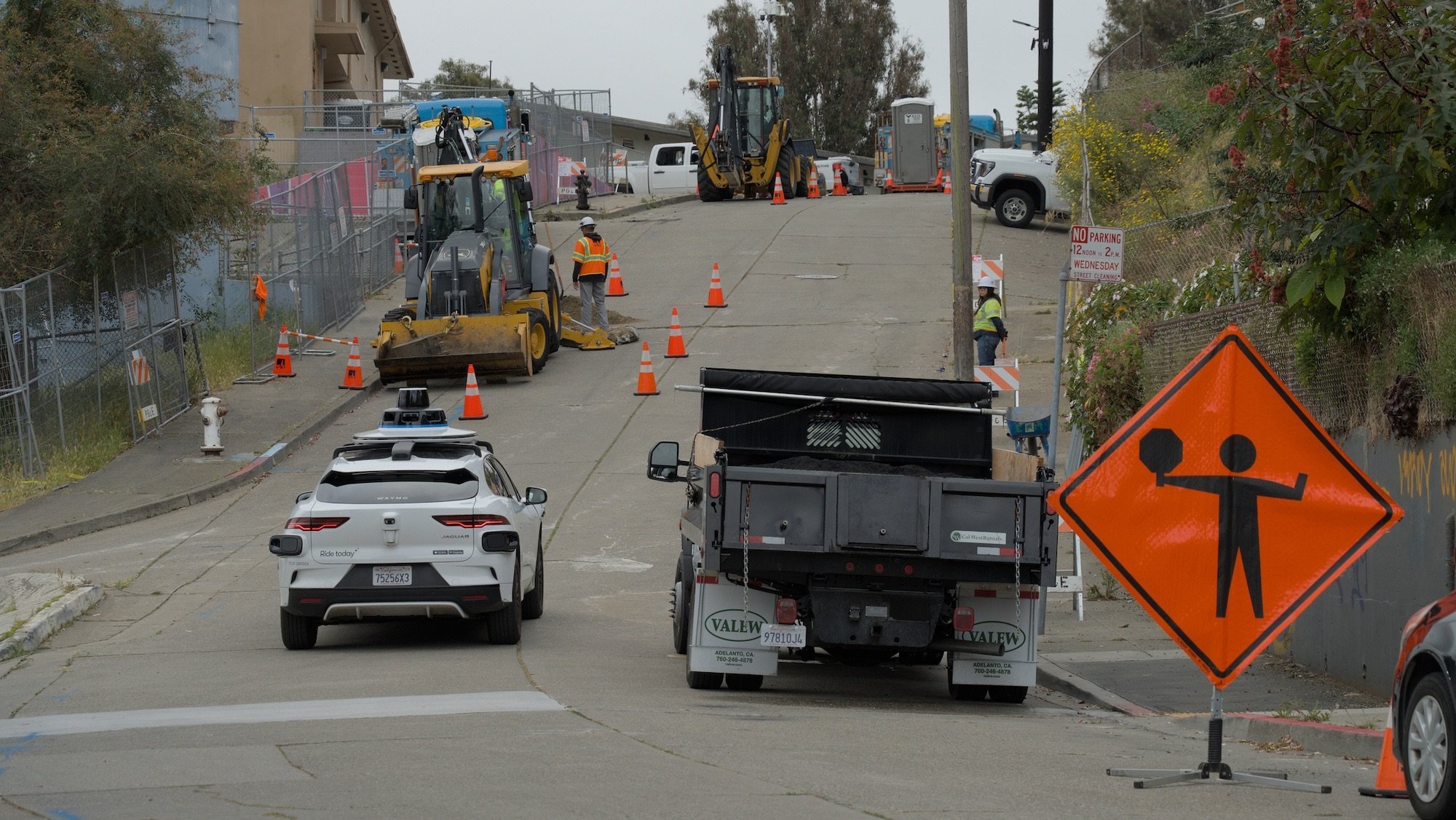
Worries about AVs breaking the law aren’t hypothetical. A recent CNN analysis of federal government records and social media footage found hundreds of driverless cars running red lights, driving into oncoming traffic, ignoring emergency road closures, and executing other potentially dangerous maneuvers. Around that same time, Waymo temporarily pulled its vehicles from highways following reports from the National Highway Traffic Safety Administration (NHTSA) of at least 13 instances where they drove into active construction zones. The company has since started resuming highway routes.
Waymo and independent supporters of AV rollouts generally have repeatedly claimed that, even when taking these issues into account, autonomous systems get into fewer crashes and drive safer than humans. Recent research lends credence to that argument in certain cases, but AVs are still limited in where and how they can operate.
“No technology is perfect, but while human drivers can only learn from their individual experiences, Waymo takes community feedback and applies those safety learnings to our entire fleet,” a Waymo spokesperson told CNN in June.
A new type of ‘ticket’ for autonomous vehicles
Regulators hope some creative new legislation can help clear up the confusion. California enacted a law allowing police to issue a “notice of noncompliance” to AVs. The whole point of these notices, and why they mark an important step forward, is to create an official record for when an AV makes a mistake, Raifman notes. Those notices are then updated in the California DMV’s system within 72 hours. Prior to this, police didn’t have a clear way to document when an AV violated the law, creating a gap that contributed to uncertainty about how well the technology works in the real world.
Still, actually punishing human drivers and AVs isn’t a one-to-one comparison. When humans make mistakes, they receive points on their driver’s license. Rack up enough points, and a driver risks losing their license altogether. As Raifman points out, notices of noncompliance attempt to apply a similar deterrent for AV companies. The notices are recorded, added up, and factored into whether state regulators continue granting those companies permits to operate autonomously. Too many violations, especially those causing major traffic issues or injuries, could lead to a company’s permit being revoked. But unlike humans, AV makers don’t have to worry about individual monetary fines for these moving violations.
“It’s an indirect mechanism to enforcement, but it is not enforcement through money and points,” Walker Smith said.
Raifman compares this enforcement method to how regulators manage pollution from power plants. Local governments often grant permits allowing a facility to emit certain pollutants, but only up to a specified amount. If a plant exceeds that or otherwise violates its permit, regulators can issue a notice of violation, which, depending on its severity, can lead to a permit suspension or even cause operation to shut down.
That’s a different process than the one facing an individual resident who pollutes their own backyard. In that case, they’d likely just receive a citation. In both the power plant case and now with AVs, enforcement relies on an ongoing back-and-forth between corporations and regulators, rather than a single punishment to an individual.
That may make sense on paper, but it’s also frustrating for everyday drivers, many of whom are just now seeing AVs spring up in their towns and on their roads without their input. The frustration shows up in comment sections and forums, with some describing what can seem like two separate rules or laws–one for humans and another for robots and their owners.
“They pay the fine and just keep doing what they are doing,” one Reddit post on the topic reads. “This is the corporate reality we live in, where corporations are supposedly people, but have none of the responsibilities or need to deal with things like following the law that the rest of us do.”
Raifman believes enforcement and accountability for driverless cars are broadly improving, but he also empathizes with annoyed drivers who feel the status quo is unfair. One major issue contributing to that frustration, he notes, is that the “pain” felt by a human driver and an AV company violating the same law isn’t equal. A robotaxi company accruing hundreds of thousands of dollars in parking tickets can simply shrug it off as a cost of doing business. For a human driver living on a budget, however, just a few tickets can severely impact their finances.
“I think that’s where there’s an asymmetric relationship compared to humans, and I think that’s a source of frustration,” Raifman says.
Autonomous vehicles are a physical manifestation of growing AI anxiety
That pent-up frustration stems, in part, from a familiar pattern in tech: innovations move fast, maybe breaking some things along the way, and regulators end up playing catch-up. Right now, cities with the most exposure to driverless cars (San Francisco, Los Angeles, Phoenix, and Austin) have just begun to sort out what fair and consistent enforcement looks like, even as the technology keeps expanding well ahead of it.
In just the last year, Waymo has nearly quintupled its fleet, from around 700 vehicles to nearly 4,000, according to The New York Times. Zoox and Tesla are both preparing significant robotaxi launches in multiple cities, and changes to federal rules mean many of these vehicles won’t even have visible steering wheels or pedals. Driverless 18-wheelers are already barreling across Texas highways, and the prospect of individual car owners swapping on true hand-off, eyes-off driving features in their own vehicles gets closer every day.
And even if the AV supporters are right that the technology is ultimately safer than humans, sheer scale means more and more people will end up watching these vehicles behave badly. In a climate where public trust in automation and AI broadly is souring, driverless carmakers may have more incentive than ever to keep their cars from running afoul of the law, not just to satisfy regulators, but because the cars themselves have become a material stand-in for how people feel about AI writ large.
“I think people are going to put a lot of their hopes and fears about AI generally disproportionately on automated vehicles because they’re so visceral and physical and real and obvious,” Walker Smith said.
In Ask Us Anything, Popular Science answers your most outlandish, mind-burning questions, from the everyday things you’ve always wondered to the bizarre things you never thought to ask. Have something you’ve always wanted to know? Ask us.

2026 Popular Science Home of the Future Awards